


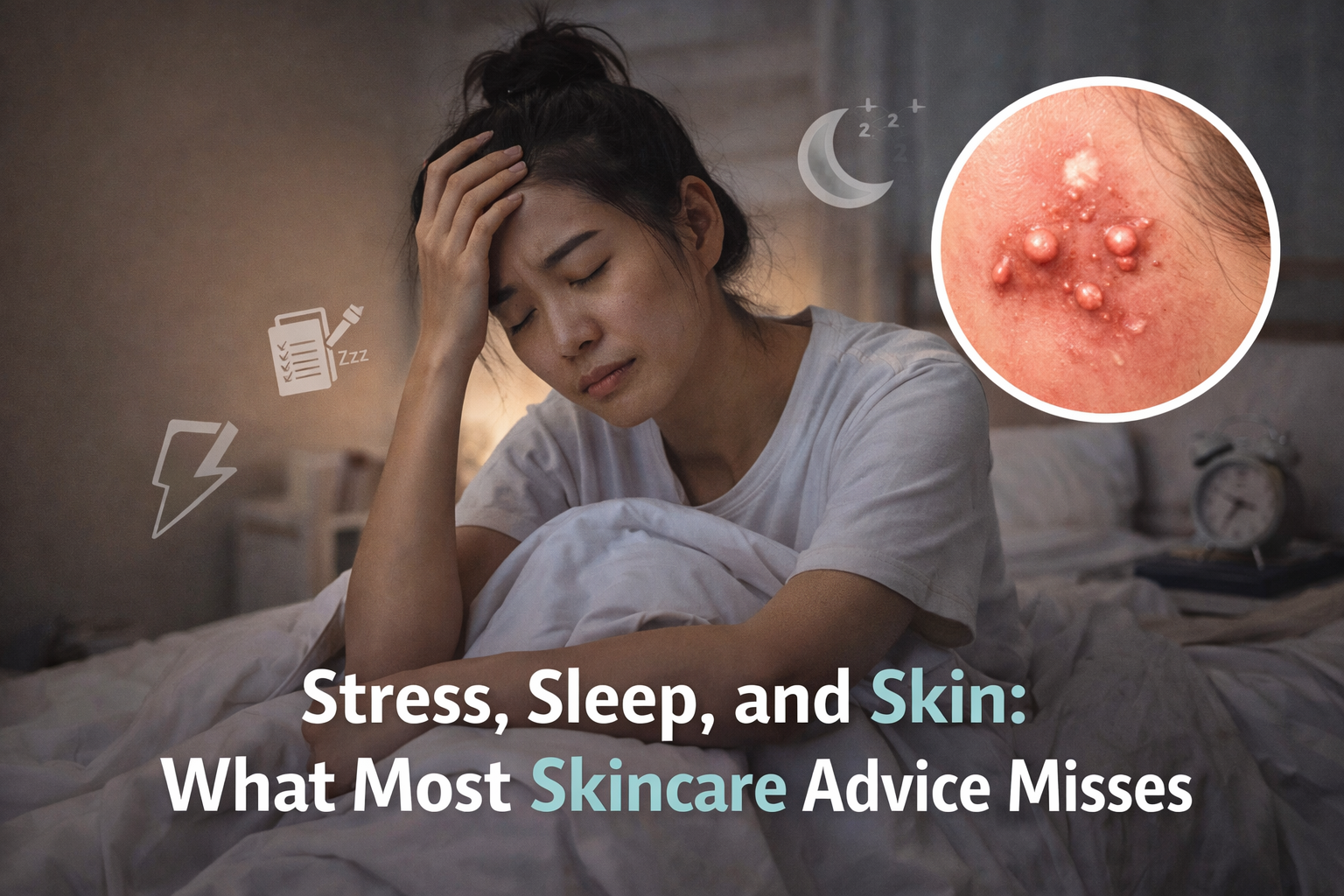
Stress, Sleep, and Skin: What Most Skincare Advice Misses
Stress and poor sleep can slow skin recovery and make the skin more reactive, dull, uneven, or unstable. When the body is under constant pressure, it focuses more on maintaining basic function than repair, which may limit how well skincare products and treatments perform.
Many people reach a point in their skincare journey where they start to wonder:
“I’ve been taking care of my skin… so why is it still unstable?”
This question is especially common among people who are constantly busy, under pressure, or not getting enough rest.
You are doing the steps.
You are using the products.
But your skin still feels unpredictable.
Some days it looks fine.
Other days it suddenly becomes dull, sensitive, or breaks out.
And it doesn’t fully make sense.
These day-to-day changes are often part of a bigger pattern rather than random events. We explain why this happens in our article on why your skin looks different every day.
Most Skincare Advice Focuses on the Outside
Traditional skincare advice usually focuses on:
- What products to use
- What treatments to do
- What ingredients to add
But very few people talk about one important thing:
What condition your skin is operating in every day.
Your skin does not function in isolation.
It responds to your daily state — physically and mentally.
When Stress and Sleep Affect Your Skin
When stress becomes constant, and sleep quality is low, the body shifts into a different mode.
Instead of focusing on repair, it focuses on maintaining basic function.
In this state:
- Recovery slows down
- Skin becomes more reactive
- Redness appears more easily
- Skin tone looks more tired or uneven
- Overall condition becomes unstable
You may notice your skin:
- Doesn’t heal as quickly as before
- Becomes sensitive more easily
- Fluctuates without clear reason
This is not because your skincare is wrong. It’s because your skin is working under pressure.
When the skin stays under pressure for long periods, the skin barrier may gradually become more reactive and sensitive. We explore this further in our article on Why Your Skin Suddenly Becomes More Sensitive Than Before.
Why More Skincare Doesn’t Always Help
When the skin becomes unstable, the natural reaction is to do more.
- Add more products
- Try stronger ingredients
- Increase treatment frequency
Many people also begin switching products more frequently, hoping the next one will solve the problem. Unfortunately, this often interrupts the skin’s ability to recover. We explain why in our article on why constantly changing skincare products may be the real problem.
But if the body is already under strain, the skin is not in a position to fully benefit from these changes.
In fact, the skin may simply be “coping” — not truly improving.
It may look slightly better for a short time, but it is not building long-term stability.
Without adjusting the overall rhythm, skincare alone has limits.
The same principle applies to facial treatments. They work best when they are matched to what your skin actually needs, rather than simply being done more often. We explore this in our article on whether facial treatments or understanding your skin works better.
Your Skin Is Part of Your Lifestyle
From a Skin Coaching perspective, stress and sleep are not separate from skin health.
They are part of it. Your skin reflects:
- How much pressure your body is under
- How much recovery time you are getting
- How stable your daily rhythm is
This doesn’t mean you need to suddenly change your entire lifestyle.
But it does mean one thing:
You need to understand what your skin is currently going through.
Understanding Your State Comes First
Instead of immediately asking, “What product should I use next?”
Try asking: “What state is my skin in right now?”
- Is it under stress?
- Is it lacking recovery?
- Is it stable, or constantly fluctuating?
When you see this clearly, your decisions change.
You stop forcing results.
You stop overloading your skin.
You start supporting it instead.
Sometimes, Less Is Not the Answer — Clarity Is
It’s not always about doing less.
And it’s not always about doing more.
It’s about doing the right thing, at the right time, for the right condition.
And that only happens when you understand your state.
Because sometimes, the real shift doesn’t come from changing your skincare.
It comes from understanding what your skin is dealing with.
Sometimes, understanding your state matters more than changing your skincare.
If you’re unsure what your skin is trying to tell you, Start With a Clear Skin Assessment explains why understanding your skin condition should always come before changing products or treatments.