

Why Do Tiny Bumps Keep Appearing on Your Face Even Without Acne?
Your face doesn’t look like it’s breaking out.
There are no big, red pimples.
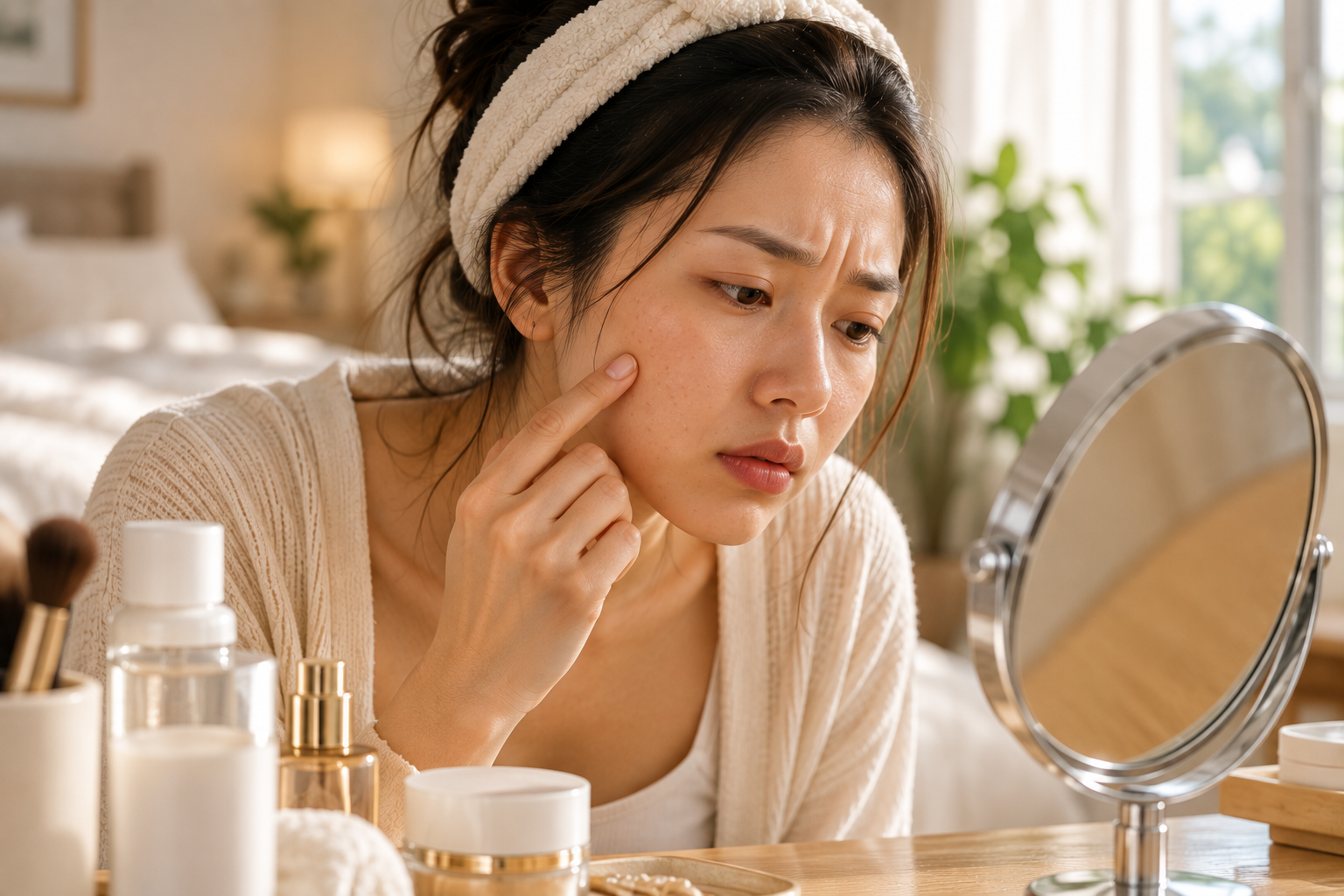
But when you look closely — especially under bright light — you can see tiny bumps across your forehead, cheeks, or chin.
And when you touch your skin, it doesn’t feel smooth.
These small bumps can have different causes. One common possibility is closed comedones, which develop when pores become clogged with oil and dead skin cells.
But not every tiny bump is the same, so understanding what you’re seeing matters before trying to treat it.
Are Tiny Bumps the Same as Acne?
Not necessarily.
Some tiny bumps may be a form of acne, while others can be related to irritation, skin texture, or other skin conditions.
Closed comedones, often called whiteheads, are a type of non-inflammatory acne. They form when a pore becomes clogged but remains covered by a thin layer of skin.
They may look like:
- Small skin-coloured bumps
- White or slightly raised spots
- Groups of bumps on the forehead or cheeks
- Uneven texture without obvious redness
- Bumps that seem to stay for weeks
Unlike an inflamed pimple, they may not feel painful at all.
Why Do Closed Comedones Keep Appearing?
There isn’t always one single reason.
Several factors can contribute to clogged pores, including:
- Excess oil
- Dead skin cells accumulating within pores
- Certain skincare or cosmetic products
- Hormonal changes
- Sweat and occlusion
- Skincare habits that don’t suit your current skin condition
This is also why two people with similar-looking bumps may not necessarily need exactly the same skincare approach.
More Cleansing Isn’t Always the Answer
When people see clogged pores, one common reaction is:
“My face must not be clean enough.”
So they wash more often, scrub harder, or start using stronger cleansing products.
But clogged pores don’t automatically mean your face is dirty.
Over-cleansing or aggressive scrubbing may irritate the skin without addressing what’s happening inside the pore.
The goal isn’t to make your skin feel squeaky clean.
It’s to manage congestion while keeping the skin comfortable and supported.
Should You Exfoliate the Bumps Away?
Exfoliation can play a role in managing some types of clogged pores, but more exfoliation isn’t always better.
If you start combining multiple acids, scrubs, peeling products, and active ingredients because you want the bumps gone quickly, your skin may become irritated.
Pay attention if the bumps are accompanied by:
- Redness
- Stinging
- Flaking
- Tightness
- Increased sensitivity
Those signs suggest there may be more going on than simple congestion.
If your skin feels rough and uneven but you’re unsure whether you’re dealing with congestion or another texture issue, our article on why skin suddenly feels rough and bumpy explains some of the other possibilities.
Look at Where and When the Bumps Appear
Instead of focusing only on getting rid of the bumps, look for patterns.
Ask yourself:
- Where do they usually appear?
- Did they start after introducing a new product?
- Is the area also very oily?
- Do they become inflamed later?
- Are you using several active ingredients?
- Have you recently changed your skincare routine?
- Do the bumps itch, sting, or become red?
These details matter because not every small bump should automatically be treated as a closed comedone.
Persistent, itchy, painful, spreading, or unusual bumps may need assessment by an appropriate healthcare professional rather than simply adding more skincare.
Can Closed Comedones Turn Into Pimples?
Sometimes, a clogged pore can become inflamed and develop into a more noticeable acne lesion.
This is one reason recurring congestion shouldn’t only be viewed as a texture problem.
If you’re also experiencing repeated breakouts, our article on why enlarged pores often lead to repeated acne breakouts explores the relationship between visible pores, congestion and acne-prone skin.
Importantly, enlarged pores themselves don’t directly cause acne. They can simply appear alongside conditions such as increased oiliness and congestion.
Understand the Bumps Before Trying to Remove Them
When you see tiny bumps, it’s tempting to immediately search for:
“The best product for closed comedones.”
But first ask:
Are these actually closed comedones?
Your skin may be dealing with congestion, irritation, dehydration, sensitivity, or another condition that looks similar from the surface.
That’s why the first step shouldn’t always be adding another acid, scrub, or acne product.
If you’re unsure what’s causing the bumps on your skin, Start With a Clear Skin Assessment explains why understanding your skin condition should come before choosing another product or treatment.
Final Takeaway
Tiny bumps don’t automatically mean your face is dirty.
And they don’t automatically mean you need stronger acne products.
Look at the type of bump, where it appears, what other symptoms are present, and what changed before it started.
Because once you understand what you’re actually dealing with, it becomes much easier to decide what your skin needs next.