


Why Does Your Skin Suddenly Feel Rough and Bumpy?
Your skin may look fine from a distance, but when you touch your face, something feels different.
Rough. Bumpy. Uneven.
Sometimes there aren’t even obvious pimples.
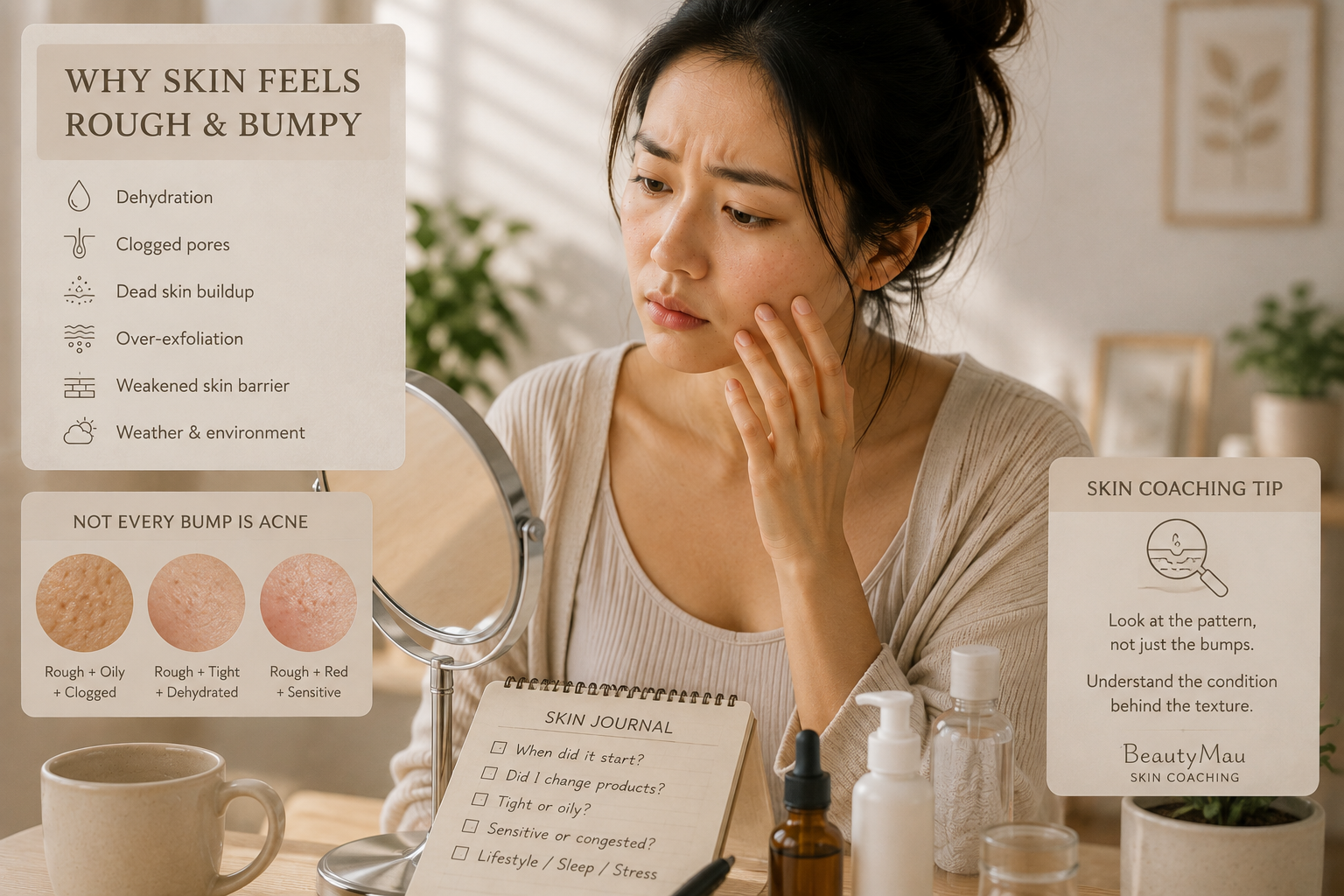
Rough and bumpy skin can be related to several factors, including dehydration, buildup of dead skin cells, clogged pores, irritation, or changes in your skin barrier.
The important question isn’t just “How do I make my skin smooth again?”
It’s “Why has my skin texture changed?”
What Does Rough and Bumpy Skin Feel Like?
Not every bump on the face is acne.
You may notice:
- Tiny bumps that are easier to feel than see
- Roughness around the cheeks or forehead
- Makeup no longer sitting smoothly
- Small clogged-looking pores
- Dry or flaky areas
- Skin that feels tight after cleansing
- An overall uneven texture
And sometimes, several of these appear together. That’s why immediately treating every bump like acne may not be the right approach.
1. Your Skin May Be Dehydrated
When skin lacks sufficient water, the surface can feel less soft and smooth.
You may notice that your skin:
- Feels tight after washing
- Looks dull
- Has fine surface lines
- Feels rough despite appearing oily
- Doesn’t hold makeup as smoothly as before
This can be especially confusing if your T-zone is also shiny. Oily skin can still experience dehydration.
If this sounds familiar, our article Can Oily Skin Still Be Dehydrated? Here’s What Most People Get Wrong explains why oil and hydration are not the same thing.
2. Your Pores May Be Congested
Oil, dead skin cells, skincare residue, and other material can accumulate within pores. When congestion develops, the surface may start to feel bumpy or uneven.
You may notice:
- Blackheads
- Whiteheads
- Small closed bumps
- More visible pores
- Repeated breakouts in certain areas
But congestion doesn’t necessarily mean you should immediately scrub or exfoliate more. Understanding what you’re actually seeing matters first.
3. You May Be Exfoliating Too Much
When skin feels rough, one of the first reactions is often:
“I need to exfoliate.”
Sometimes exfoliation can help. But more isn’t always better.
Using acids, scrubs, exfoliating toners, retinoids, or multiple active ingredients too frequently may leave some people’s skin feeling irritated, dry, or more sensitive.
If your skin becomes rough and starts stinging, feeling tight, or becoming unusually sensitive, don’t automatically assume it needs stronger exfoliation.
4. Your Skincare Routine May Have Changed
Think about when the roughness started.
Did you recently:
- Introduce a new product?
- Change your cleanser?
- Start using stronger active ingredients?
- Increase exfoliation?
- Stop using moisturiser?
- Start several new products together?
When several things change at once, it becomes difficult to know what your skin is responding to. This is one reason constantly switching skincare can make understanding your skin harder.
5. Your Skin Barrier May Need Attention
Your skin barrier helps reduce water loss and protects the skin from external irritants.
When it is disrupted, you may notice changes such as dryness, tightness, flaking, discomfort, or increased sensitivity.
This doesn’t mean every case of rough skin is a “damaged skin barrier.”
But if rough texture appears together with redness, sensitivity, stinging or unusual dryness, barrier condition is worth considering.
Should You Exfoliate Rough Skin?
Not automatically.
Before reaching for another acid or scrub, look at the other signs your skin is giving you.
For example:
Rough + clogged + oily
may need a different approach from:
Rough + tight + dehydrated
And both may need a different approach from:
Rough + red + sensitive
They can look similar in the mirror but represent very different skin conditions.
That’s exactly why identifying the condition matters before choosing the solution.
Look at the Pattern, Not Just the Bumps
Instead of focusing only on making your skin smooth as quickly as possible, ask:
- When did the texture change?
- Is my skin oily, dry, or both?
- Does it feel tight after cleansing?
- Are the bumps clogged or inflamed?
- Has my skin become more sensitive?
- What products did I recently introduce?
- Am I exfoliating more than before?
These questions can give you much more useful information than simply labelling everything as “rough skin.”
Understand Before You Correct
Smooth skin isn’t about exfoliating as much as possible.
Depending on what’s happening, your skin may need help with hydration, congestion, barrier support, skincare habits, or another concern entirely.
That’s why the first step should be understanding what kind of roughness you’re dealing with.
If you’re unsure why your skin texture has changed, Start With a Clear Skin Assessment explains why understanding your current skin condition should come before choosing another product or treatment.
Final Takeaway
If your face suddenly feels rough and bumpy, don’t immediately attack it with stronger products.
Observe first.
Is it dehydrated?
Congested?
Sensitive?
Over-exfoliated?
Or has something recently changed in your routine?
The bumps are what you can see and feel.
Understanding why they’re appearing is what helps you decide what to do next.